
In recent years, the robotics sector has continued to gain momentum, and discussion has gradually shifted from laboratories, exhibitions and funding announcements to production sites. For factory managers, bringing equipment onto the factory floor is only the first step, and the more practical question is: How exactly do these robots perform their work, and can they be reliably integrated into existing production lines? Consider a robotic arm responsible for picking and placing parts. Positioned between a parts tray and a designated workstation, it picks up a part from the tray, moves it to the target location, releases the gripper, then returns to its starting point to await the next cycle. Viewed on its own, this sequence looks smooth and accomplished, as though the robot naturally knows what to do.
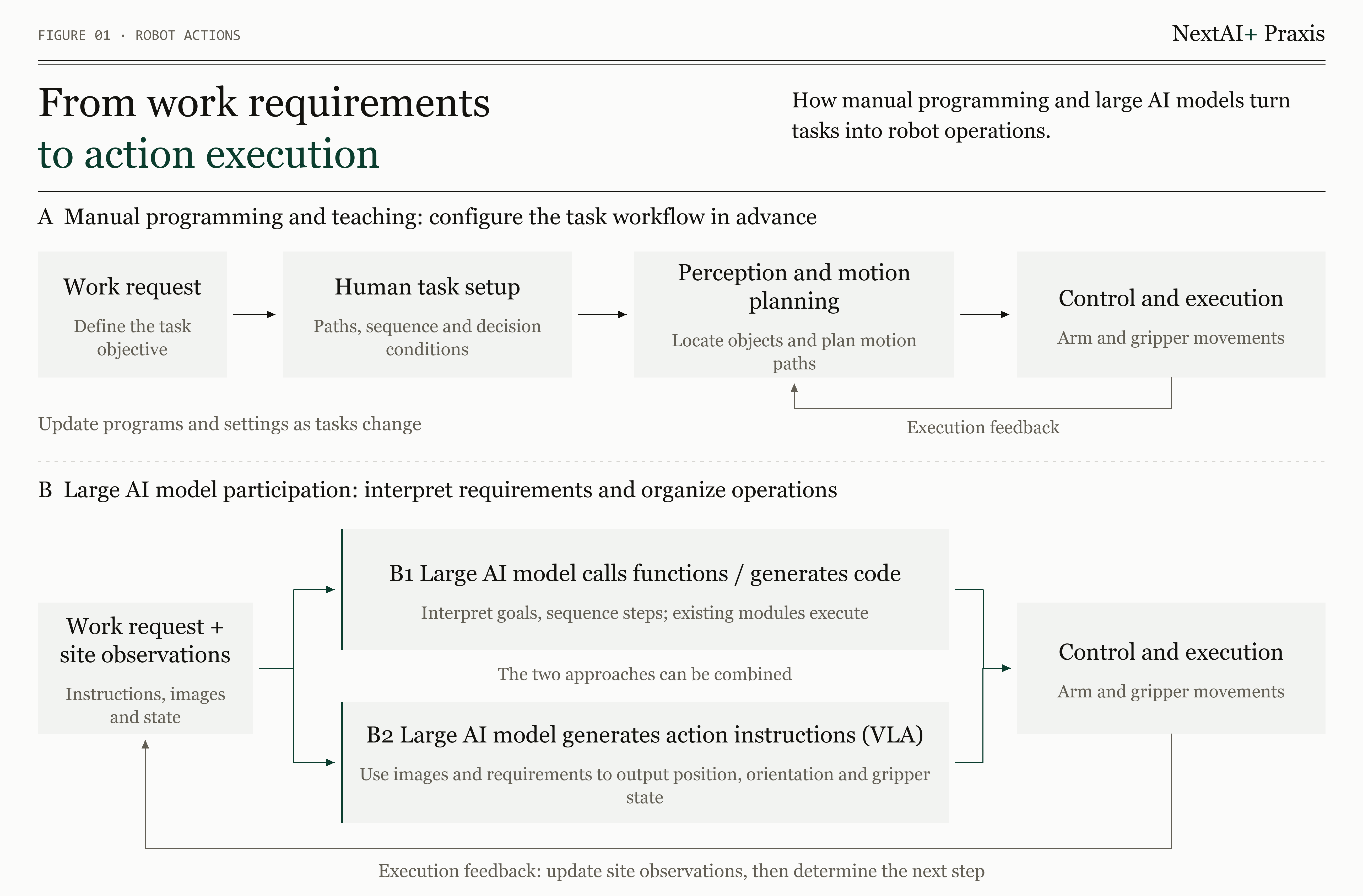
This consistent repetition is not an innate ability; it usually rests on a set of preparations that have already been completed: Engineers first break down the task, determine grasping positions, motion paths and execution sequences, set the speed, gripping method and decision conditions, then use teaching and commissioning to make the equipment operate as required. In “The First Program”, Danish collaborative robot company Universal Robots describes the specific steps involved: operators move the arm using a teach pendant, or guide it by hand, record a series of waypoints, then combine these with conditional logic, loops and equipment signals to organize the movements into an executable program.
However, a company's work does not remain unchanged indefinitely. The same production line may need to handle parts of different specifications, packaging materials may change, and trays and workstations may be repositioned. Whether the original grasping method still applies, whether new movements might interfere with nearby equipment, and whether downstream processes can accommodate them all need to be checked again. Some changes require only parameter adjustments; others involve coordinated changes to fixtures, workflows, programs and the site layout.
Existing robotic systems already have some ability to adjust to these changes. Using vision, sensors and motion planning, a system can detect changes in object positions and its surroundings, and adjust its movements accordingly. For example, the global open-source robot motion planning platform MoveIt describes how global and local planning work together in its “Hybrid Planning” technical documentation: the system first plans an overall motion path, then adjusts it during execution using feedback from the site; if a new obstacle makes the original path unusable, the robot can pause and wait for a feasible path to be replanned before continuing.
These capabilities allow robots to handle a certain range of on-site changes. However, they still depend on task objectives, perception capabilities and control rules that have already been configured. When changes involve new objects to be handled, process requirements or assessment criteria, people still need to determine which situations the existing solution can cover and which capabilities need to be reconfigured. Companies hope to further reduce precisely this robot adaptation work that recurs whenever tasks change.
Large AI Models Enter Embodied Intelligence, Offering New Ways for Robots to Adapt to Change
Large AI models may offer a new solution to the repeated configuration and commissioning required when robot tasks change: enabling robots to use models to understand work requirements, assess on-site conditions, and organize operations using experience they have already learned. Along these lines, large-model companies are attempting to extend their existing model capabilities to robots, while robot manufacturers are starting from equipment development and practical operations to explore how these capabilities can improve robot adaptability. The two sides' explorations are gradually converging in embodied intelligence.
In its official Robotics Software Engineer job posting, prominent US artificial intelligence company OpenAI describes a Robotics team focused on general-purpose robots, with work spanning different robot forms, control interfaces, data collection and evaluation; related developments have also emerged in China: according to an October 13, 2026 report by the STAR Market Daily, DeepSeek founder Liang Wenfeng is considering a further move into embodied intelligence through an in-house team or investment.
Beyond team building and investment exploration, some companies have already disclosed specific models and application trials. In June 2026, Chinese cloud computing provider Alibaba Cloud introduced “Entering the Physical AI Era: Introducing the Qwen-Robot Suite”, releasing models for robot manipulation, navigation and predicting environmental changes, and disclosing pilots with selected enterprise customers in the robotics sector; prominent US technology company Google published “Gemini 4 Argon for Robotics” on October 13, presenting research demonstrations of models participating in robot control, simulation environment reconstruction and action improvement. The role of models in robotics is extending from understanding tasks to developing and testing operational capabilities.
Meanwhile, robot manufacturers are also actively exploring this approach. On October 22, 2026, Wang Xingxing, founder of Chinese robotics company Unitree, said at the company's World Physical AI Conference and Partner Ecosystem Conference that people still paid insufficient attention to AI's potential, himself included. He explained that Unitree is experimenting with model participation in code generation, data collection, testing and training, followed by further iteration incorporating human feedback, to improve the connection between models and real robot operations. He also noted that grasping an object a robot has never seen can still reduce its success rate; helping models better handle such situations is one of the directions the company is exploring.
Embodied intelligence concerns how a system perceives its environment through a body, takes action, and completes tasks through interaction with that environment. It can take the form of robotic arms, mobile robots or humanoid robots. For companies, both sides' explorations ultimately need to answer the same question: whether robots can use learned experience to handle new work requirements and reduce the burden of reconfiguration each time a task changes. To understand this possibility, we need to look more closely at how models turn work objectives and on-site observations into actions that robots can execute.
How Large AI Models Turn Work Requirements into Robot Actions
To understand this change, we can return to the parts pick-and-place scenario. Suppose a worker gives an instruction: “Put the metal bracket in the parts tray into the empty tray on the right.” To perform this task, the system first needs to connect the language to the scene: which object is the metal bracket, which tray “on the right” refers to, and whether the destination has enough space. An important part of a large AI model's role is to combine the task description with on-site observations to determine what to handle and what result is required.
Once the objective is clear, there are broadly two ways for the model to participate in the operation:
The first is “the model interprets the objective, and existing functions execute the actions”. The model does not directly calculate every movement of the robotic arm, but calls grasping, moving and placing functions already configured in the system, passes “which bracket to grasp and which tray to place it in” as parameters to the relevant modules, and leaves the existing planning and control system to determine how to approach the object, move the arm and complete the placement. In this example, the model resolves “what to do, which object to act on, and where to put it”, while established modules still handle the specific “how”. In its 2025 introduction to Gemini Robotics-ER, Google DeepMind, Google's UK-based artificial intelligence research organization, explained in detail the approach of combining a model's spatial understanding with a robot's existing programs.
The second is “the model goes further to generate action instructions”. These models are commonly called vision—language—action models, or VLAs. They directly connect visual observations, language requirements and robot actions; their outputs can include not only objectives but also changes in the arm's end-effector position, orientation and gripper state. Returning to the bracket pick-and-place example, these outputs need to specify: where the arm should move next, at what orientation it should approach, and when the gripper should close or open. Google DeepMind introduced this direction as early as 2023 in “RT-2: New Model Translates Vision and Language into Action”.
The two approaches can be combined: a model may handle only high-level interpretation, or go further to generate actions; the level at which it participates depends on the system design.
Whether a model outputs target parameters or action instructions, these ultimately need to pass through the robot's control system to become physical movements. How the arm's joints coordinate, how speed and force are limited, and how the system stops when an exception occurs all require appropriate control and safety mechanisms. Google's public description of Gemini Robotics On-Device also explicitly explains how the model works with low-level safety-critical controllers to execute actions.
During execution, on-site observations continue to inform the next operation. Whether the bracket has moved as the arm approaches; whether the gripper has actually secured the part after closing; and whether the part can be placed as required once the arm is above the tray all need to be checked using feedback. If a grasp fails, the system needs to adjust subsequent operations within permitted limits; if it encounters an unrecognizable object or a situation outside its operating scope, it should stop or refer the matter to a person for confirmation. A pick-and-place task thus becomes a continuous process of understanding requirements, organizing operations and checking execution.
Where the Enterprise Opportunity Lies: Reducing Adaptation Work Caused by On-Site Changes
For companies, one opportunity worth watching as large AI models enter robotic systems is making equipment better able to cope with changes in everyday operations. The same equipment may already perform pick-and-place work, but changes to part specifications, tray positions or workstations often require further checks and commissioning. If a large AI model can handle some of these changes, companies have an opportunity to reduce repeated configuration work and enable existing equipment to cover a wider range of real operating conditions.
Returning to bracket pick-and-place, the bracket's orientation and the tray's position have changed, but the task objective of “taking out the bracket and placing it in the tray” remains the same. The connections between object features, spatial relationships and operations that the large AI model learned during earlier training can provide a basis for assessing the new situation. Within the range of its capabilities, the model may identify objects, determine positions and organize operations from new images, reducing the need for engineers to reconfigure the system for every arrangement. This application of learned capabilities to new situations is commonly called “generalization”. In its public introduction to Gemini Robotics, Google DeepMind demonstrated tests involving new objects, different instructions and new environments.
Following this direction, companies can first examine work with relatively clear task objectives but frequent changes in the objects handled and their arrangement. Examples include sorting and picking and placing multiple types of materials, loading and unloading products of different specifications, and auxiliary operations involving frequent changeovers. In these scenarios, the point to test is: whether, within equipment and safety limits, a large AI model can recognize changes, adjust operations and reduce the frequency of manual reconfiguration and commissioning. For workstations with long-stable tasks and well-functioning automation, companies can continue using established solutions and apply new capabilities to adaptation problems that remain unresolved.
Assessing whether this opportunity holds requires a comparison with the company's existing way of working. The visual localization, motion planning and feedback capabilities already available in existing robots should all be included in the baseline. A company can select a specific task, test several changes encountered in everyday operations, and record the adjustments each approach requires and its performance after those adjustments.
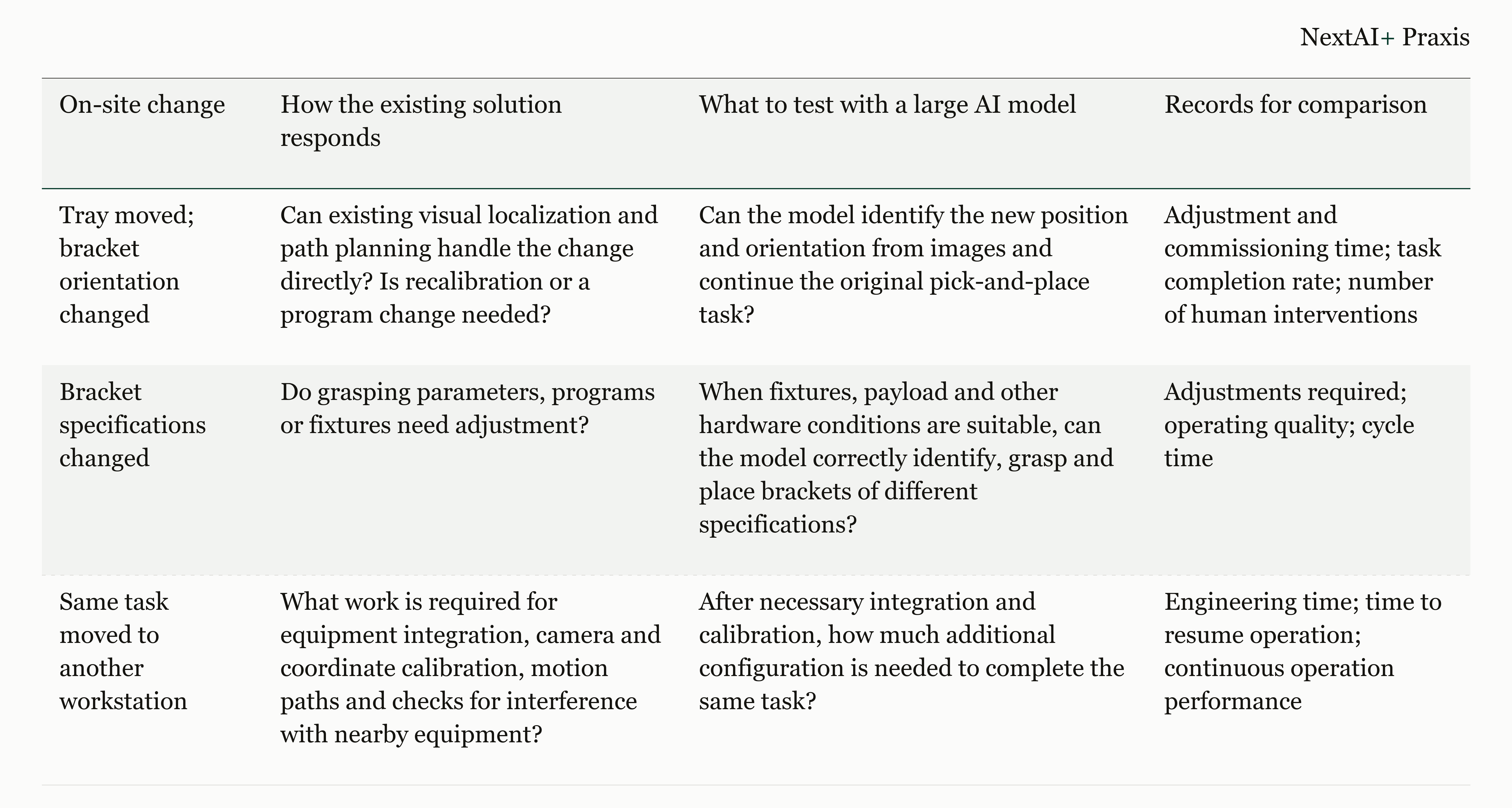
After adaptation work has been reduced, execution results still need to be checked. Whether the robot maintains acceptable operating quality across different arrangements and specifications, meets cycle-time requirements, and requires human intervention after failures all affect whether the solution can actually be used in production. Reduced reconfiguration and commissioning work, together with day-to-day performance that meets the company's requirements, provides a practical basis for expanding deployment. A company can first validate these changes in one task, then decide whether to extend the approach to related operations or other workstations.
Conclusion: Bringing Robots Closer to the Work Companies Actually Do
Large AI models entering robotic systems provide a new technical path for understanding work requirements, organizing operations and responding to on-site changes. As these capabilities develop, some work that previously required people to break it down and configure it step by step may become possible for robots to handle by combining instructions with on-site observations. This gives companies another option: retaining existing equipment and established control capabilities while exploring how robots can take on operations with greater variability.
The significance of this opportunity ultimately lies in how companies can organize their work. When product specifications need to change and orders become more varied, robots that can more readily keep up with these changes could allow automation to reach activities where adaptation previously required substantial investment and sustained use was difficult. Bringing equipment closer to real business changes, and enabling companies to expand automation with an investment they can afford, is a direction worth continuing to watch as large AI models enter embodied intelligence.
Cite as · Enterprise AI Deployment Signals · 28 October 2026