
Today, discussions about enterprise AI deployment often assume a simple premise: if an AI tool is effective and clearly improves a workflow, it can gradually be scaled and reused across the organization. That assumption has a practical basis in many office scenarios. In lower-sensitivity collaboration and productivity settings, enterprises can indeed begin with trials focused on efficiency gains, then add governance rules, data boundaries, and employee guidance based on actual usage.
But as AI moves from office assistance into deeper business processes, the fact that a tool is “useful” is no longer sufficient to justify deployment across every production scenario. Within the same enterprise, AI applications can sit at very different risk levels: some involve only low-sensitivity information and employee assistance, while others touch customer data, transaction records, internal approvals, core systems, and critical decisions. AI deployment therefore cannot advance based only on tool effectiveness; enterprises also need to determine, based on scenario risk, what environment the AI should run in.
This issue becomes visible first in highly regulated sectors such as the public sector, financial services, healthcare, energy, and large state-owned capital organizations. The reason is straightforward: data is more sensitive, regulatory requirements are clearer, and accountability boundaries are more explicit. When financial institutions discuss AI, for example, the concern is often not only whether the output is accurate, but also how customer data, transaction information, internal systems, and third-party models are accessed, transmitted, and retained during AI use. HSBC, in discussing its AI applications, has highlighted AI’s use in fraud prevention, market analysis, and customer service while placing AI risk management, strong control infrastructure, and centralized governance within the same narrative. Kaiser Permanente likewise repeatedly emphasizes patient safety, privacy protection, transparency, and accountability when publicly discussing medical AI. For these industries, AI deployment risk does not arise only at the moment an output is produced; it runs through the entire process of data ingestion, model invocation, system integration, and business execution.
The core argument of this article can therefore be summarized in two points:
- When enterprises move AI into production, they should first determine the deployment model based on scenario risk. Low-sensitivity office and collaboration scenarios can prioritize public cloud or SaaS AI. Scenarios involving sensitive data, core systems, and critical processes require further assessment of local cloud, private deployment, hybrid architecture, or sovereign AI.
- Highly regulated industries are where this requirement becomes visible first. The public sector, financial services, healthcare, energy, and large state-owned capital organizations have stronger requirements for data residency, access control, auditability, and accountability. They therefore reach the point earlier where “where should AI run, who should manage it, and can its actions be traced?” become questions that must be answered before an AI project enters production.
Scenario Risk Is a Key Reference Point When Enterprises Choose an AI Deployment Model
When enterprises adopt AI, they may appear to be choosing a tool, model, or agent product. From a deployment perspective, however, the real choice is where the AI capability runs, who maintains it, how data flows, and whether the enterprise can retain control over the full process. Public cloud, SaaS, local cloud, private deployment, and sovereign cloud are different operating foundations built around these questions.
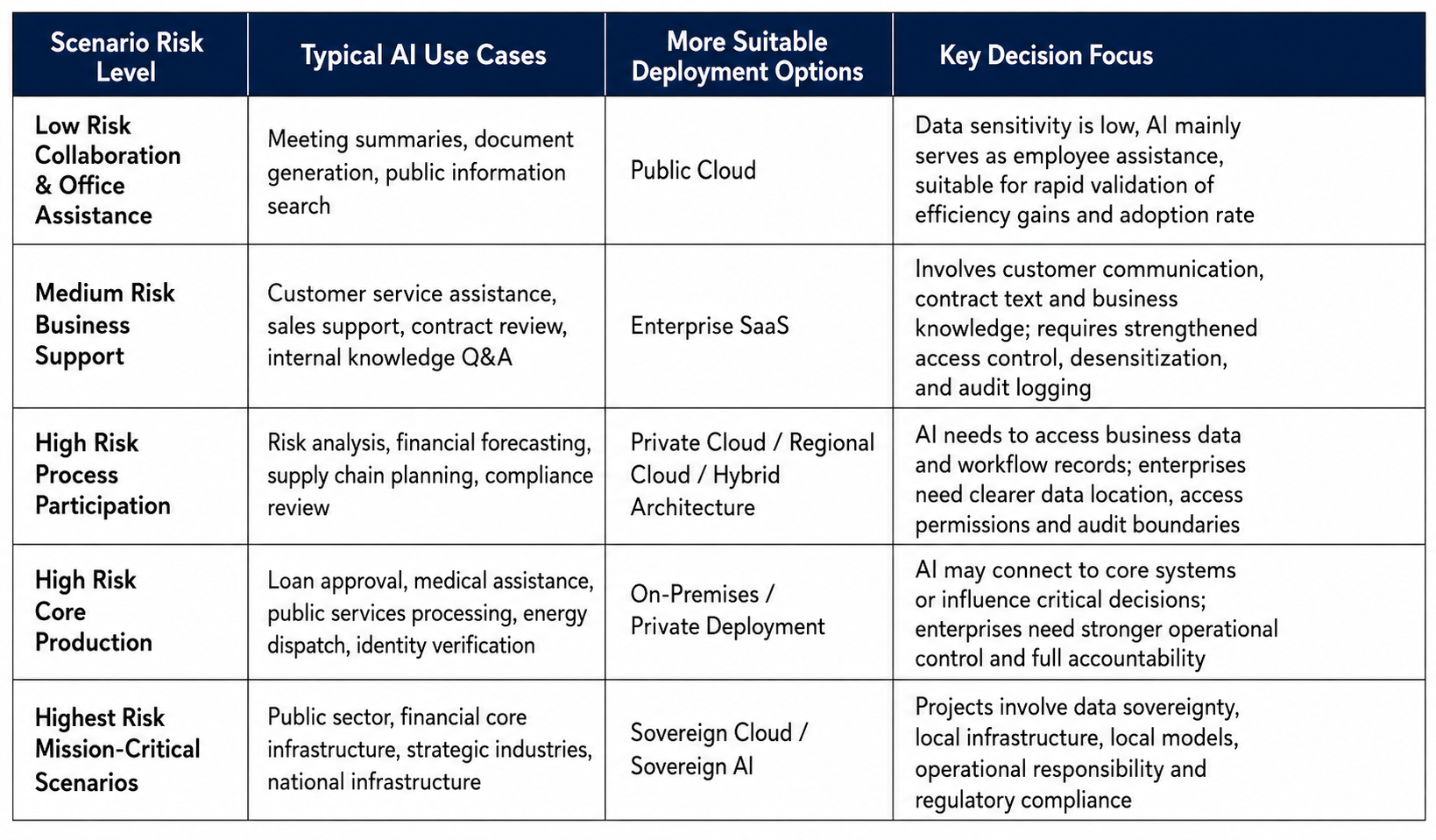
For many general enterprises, AI applications often begin in public-cloud or SaaS form. The reason is direct: these tools are fast to launch, lightweight to procure, frequently updated, and easier to embed into meetings, documents, search, customer service, sales, and everyday office workflows. But once AI enters higher-risk business scenarios, deployment architecture can no longer be determined by convenience alone. The enterprise first needs to determine what data the scenario will touch, which systems it will connect to, and whether later auditing and accountability will be required.
Vendors Are Moving AI Capabilities into More Controlled Deployment Models
Once AI enters production workflows, enterprise requirements become more complex than they were during the office-assistance stage. The system needs to demonstrate that it can improve business efficiency, but it must also show that its operating model will not weaken the enterprise’s existing data-security, permission-management, and audit-traceability systems. Recent moves by vendors are responding to this “dual requirement”: models, agents, and automation capabilities continue to improve, but they are also increasingly being placed inside more controlled operating foundations such as local cloud, on-premises deployment, and sovereign cloud.
UiPath Brings Agentic AI into Customer-Controlled Environments
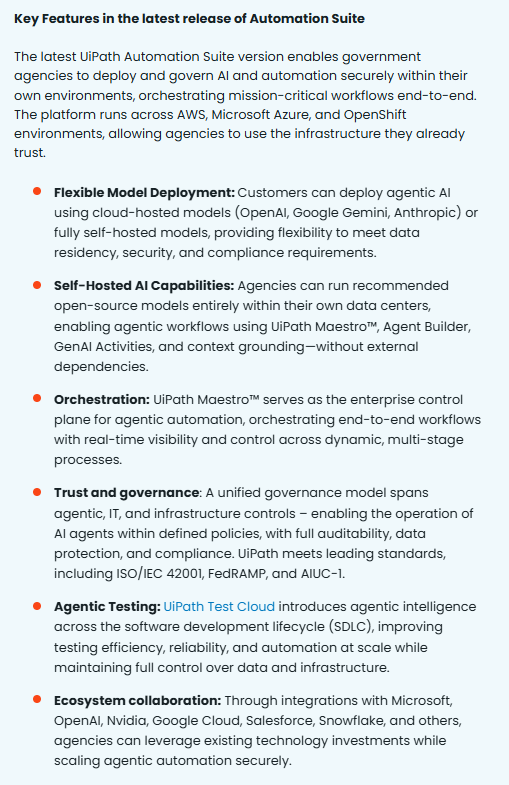
From a deployment perspective, the core signal from U.S. agentic automation provider UiPath is that agentic AI is being brought into on-premises environments. On May 5, 2026, UiPath added agentic AI capabilities to Automation Suite and explicitly positioned the update for government agencies and regulated industries in UiPath Automation Suite Delivers On-Premises Agentic AI for the Public Sector. According to UiPath, the updated Automation Suite allows customers to deploy AI and automation capabilities within infrastructure they choose and manage, including environments such as Amazon Web Services (AWS), Microsoft Azure, and OpenShift. This makes it easier to bring agentic AI under existing enterprise systems for identity and access management, data governance, logging and auditing, and security management.
This matters particularly for higher-risk processes. Once agentic AI moves from office assistance into process execution, it may participate in task assignment, system invocation, approval routing, and exception handling, while also accessing customer data, business rules, and core-system interfaces. By placing agentic AI capabilities inside Automation Suite, UiPath is effectively offering an evaluation path that can be accepted more readily by enterprise security architectures: enterprises can test whether agentic automation can enter more complex business processes without breaking the trust relationships embedded in their existing infrastructure.
UiPath’s subsequent launch of Automation Cloud in South Korea provides an additional signal in the same direction. On May 19, 2026, UiPath announced a collaboration with Microsoft to provide local cloud capabilities in South Korea. The title of the announcement explicitly refers to “data sovereignty”: UiPath Launches Automation Cloud in South Korea to Meet Surging Demand for Data Sovereignty. Compared with on-premises deployment, local cloud addresses a broader set of enterprise cloud requirements. Enterprises still want continuous updates, platform-based management, and agentic capabilities from cloud services, but they also want clearer boundaries around data location, service operations, and regional compliance. This signal shows that controlled deployment is not limited to private or on-premises environments. Even within cloud models, vendors are increasing enterprise control by providing domestic data residency and regional cloud capabilities.
SoftBank and Oracle Turn Sovereign AI into a Combination of Model, Cloud Platform, and Local Operations
On April 16, 2026, Japanese AI services provider SoftBank, U.S. cloud infrastructure provider Oracle, and Japanese large language model developer SB Intuitions, a SoftBank subsidiary, jointly announced that SoftBank would begin offering enterprises and local governments high-precision generative AI services from June 2026 by combining the homegrown large language model Sarashina with Cloud PF Type A powered by Oracle Alloy, in an environment designed to ensure data sovereignty. The announcement was titled SoftBank Corp. to Launch Generative AI Services Using Homegrown LLM "Sarashina" on Cloud PF Type A with Oracle Alloy from June 2026.
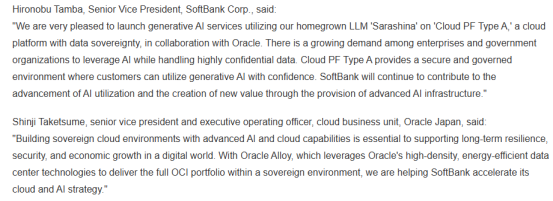
This signal corresponds to deployment needs in the most constrained scenarios: sovereign AI. Its rigor first appears in the way it institutionalizes the question of “where AI runs.” Cloud PF Type A deploys cloud infrastructure powered by Oracle Alloy in SoftBank data centers in Japan, with SoftBank responsible for management and operations. This allows enterprises and public-sector organizations using generative AI to explain more clearly where data is located, who operates the cloud environment, and where service responsibilities sit. For enterprises and local governments, this means generative AI can be combined with confidential information and business data within a domestic data environment without exposing sensitive data to an external operating environment that is more difficult to explain.
SoftBank and Oracle’s collaboration therefore looks less like a simple capability launch and more like an attempt to package sovereign AI as a deliverable deployment model. The core problem it addresses is not capability, but trust: only when data location, operating responsibility, and accountability boundaries are clearly defined can generative AI realistically enter more highly constrained business scenarios.
When Enterprises Procure AI, They Are Increasingly Paying for “Production Control”
The emergence of local cloud, on-premises deployment, and sovereign AI on the vendor side reflects a change in enterprise AI budget logic. In low-risk office scenarios, enterprises mainly pay for software accounts, model calls, and employee trials. But when AI enters higher-risk production processes, spending moves earlier toward the operating environment, permission systems, logging and auditing, and compliance explainability. The core capability enterprises are purchasing is the ability to run AI in a controlled environment that can be accepted by both internal security systems and external regulatory requirements.
The first category of spending is deployment-model assessment. This corresponds to risk classification before an AI project starts: which scenarios can use public cloud or SaaS, which require local cloud, which need private deployment, which require sovereign AI, and which are not yet suitable for production. The U.S. National Institute of Standards and Technology (NIST) AI Risk Management Framework is not a procurement guide, but it offers an important implication for enterprise AI deployment: AI governance should begin with the specific use case, impact scope, and risk identification before moving into measurement, management, and governance. Applied to enterprise procurement, this means that before selecting a tool, enterprises need the capability to classify scenarios, identify data boundaries, and design a deployment path.
This is precisely where NextAI+ Praxis can support enterprise budgets. For organizations that have not yet completed their first round of deployment decisions, NextAI+ Praxis focuses on establishing a clear relationship among “scenario risk—deployment model—pilot conditions” before procurement:
- Map candidate AI use cases and return to real business processes to identify the data types, system interfaces, process nodes, and decision impacts the AI may touch. Determine whether each scenario belongs to low-risk office collaboration, medium-risk business assistance, or a high-risk production process.
- Define data and system boundaries and match them to deployment models. Determine whether the AI will access customer data, transaction records, internal approvals, core systems, or sensitive business knowledge, then assess whether public cloud, enterprise SaaS, local cloud, private deployment, or sovereign AI is the appropriate model.
- Design a verifiable pilot path. Once the deployment model is determined, select priority scenarios and define the data, permissions, logs, audit requirements, and system connections required for the PoC, so that the pilot begins by validating production conditions rather than stopping at a functional demo.
Once these three steps are completed, deployment-model assessment spending becomes an executable pre-procurement activity rather than an abstract review. What the enterprise receives is not simply a recommendation to trial a particular AI tool, but a clearer deployment roadmap: which scenarios can be tested quickly, which require stronger controls, and which should not enter production until data and system conditions are in place.
The second category of spending is the controlled operating foundation. Once AI begins to access sensitive data, core systems, and critical processes, enterprises will pay for stronger control. Oliver Williamson’s work on economic governance and firm boundaries offers one explanation: as uncertainty, asset specificity, and control requirements increase, organizations tend to choose governance arrangements with greater control. Applied to AI deployment, low-risk scenarios can prioritize general-purpose SaaS, while high-risk scenarios drive spending on on-premises deployment, private environments, data residency, access control, and log retention. These budgets were previously distributed across cloud infrastructure, information security, data governance, and IT architecture; AI production deployment is now reorganizing them around a common objective.
High-risk AI project budgets therefore will not be limited to the question of “which tool should we buy?” They will first go toward two things: determining scenario risk and building a controlled operating foundation. In the short term, this may appear as consulting, security assessment, architecture design, and vendor selection. Over the longer term, it will solidify into internal enterprise standards for AI deployment. The closer AI moves to real production processes, the more enterprises will pay for control, explainability, and clearly defined accountability.
The signals in this issue suggest that the key question in enterprise AI production deployment is shifting from whether a tool is effective to whether its operating conditions are sufficiently clear. Enterprises need to assess scenario risk first, then select an appropriate deployment model, and bring data location, system connections, permission auditing, and accountability boundaries forward into pilot design. Only when the AI operating environment can be jointly accepted by security, compliance, and business teams can a system move from limited trial into a sustainable production process.
Further Reading
The following public research and cases were cited in the analysis or are worth sharing for further reading. Publication years and titles follow official sources where available:
- HSBC, There’s a Risk in Missing the AI Opportunity, 2025.
- Kaiser Permanente, AI in Health Care: 7 Principles of Responsible Use, 2025.
- Kaiser Permanente, Artificial Intelligence, 2025.
- NIST, Artificial Intelligence Risk Management Framework, 2023.
- NIST, The NIST Definition of Cloud Computing, 2011.
- UiPath, UiPath Automation Suite Delivers On-Premises Agentic AI for Public Sector, 2026.
- UiPath, UiPath Launches Automation Cloud in South Korea to Meet Surging Demand for Data Sovereignty, 2026.
- SoftBank Corp. / Oracle / SB Intuitions,SoftBank Corp. to Launch Generative AI Services Using Homegrown LLM “Sarashina” on Cloud PF Type A with Oracle Alloy from June 2026, 2026.
- Oracle, Dedicated and Sovereign Cloud Deployments, 2026.
- Oliver E. Williamson, Transaction Cost Economics: The Natural Progression, Nobel Prize Lecture, 2009.
Cite as · Enterprise AI Deployment Signals · 18 August 2026