
When companies ask employees to complete a task with AI, they often add a requirement: a human must review the result. This keeps final judgment in human hands, while also assigning employees specific work—explaining the business context, identifying problems in the response, finding evidence to check it against, and deciding whether the revised output is fit for use.
These activities require expertise, information, and time. If an organization requires human review without specifying what must be checked, under what conditions, and by whom, the reliability of that division of work remains uncertain.
We believe companies adopting AI need to deliberately design the judgment and correction work that people are expected to perform. Whether human-led collaboration becomes reliable depends on whether this work is clearly assigned and adequately supported.
Research from Stanford University’s Social and Language Technologies (SALT) Lab offers useful evidence for understanding this shift. In Human–AI Collaboration at Scale, the researchers used a privacy-preserving analysis tool to study nearly 250,000 real Claude.ai conversations. They examined the stakes of the tasks, the roles people retained, and how users responded when collaboration encountered problems. Anthropic publicly introduced the external research initiative supporting this study on August 26, 2026.
The sample consists of consumer Claude.ai conversations from April 25 to May 9, 2026, across Free, Pro, and Max plans. It excludes agentic products such as Claude Code and Claude Cowork. These observations offer insights relevant to companies, but applying them to organizational practice requires distinguishing patterns of participation from actual work outcomes and recognizing the limits of the evidence.
Reliable Human-Led Collaboration Depends on What People Actually Do
The study reports that 72% of assessable conversations fall into the category “human leads, AI assists.” Separately, 49.7% of conversations contain some form of friction, including unclear requests, misunderstandings, capability limitations, and incorrect outputs.
These percentages describe different dimensions of collaboration. They do not establish that the same conversations exhibit both characteristics. Considered together, however, they raise a more specific question: When people remain involved in AI-assisted work, what judgment and correction tasks do they perform, and what capabilities and conditions do those tasks require?
The paper uses the Human Agency Scale (HAS) to classify collaboration according to the degree of human involvement required to complete a task. The “human leads, AI assists” category means that the AI needs human input to complete the task successfully. This captures the necessity of human participation without directly distinguishing its specific contribution. Providing context, refining requirements, checking facts, and correcting errors can all represent human involvement.
Companies therefore need to look more closely at the work employees perform within human-led collaboration. An employee may be exercising professional judgment to decide which recommendations are worth adopting. They may also be supplying information the AI lacks, repeatedly explaining requirements, or trying to resolve problems in its output. Each contribution can be valuable, but the capabilities and support it requires will differ.
Describing all of these activities as “human oversight” can obscure the work required to turn AI output into a usable result. The study does not measure how much time these activities consume or whether they offset the benefits of AI. It does, however, encourage companies to assess collaboration quality through the actual division of work between people and AI.
Judgment and Correction Need to Be Explicitly Assigned
Among conversations containing friction, 42% are classified as involving compounding user and model issues—for example, an underspecified request followed by a model misunderstanding. Model-initiated friction accounts for another 38.6%, and user-initiated friction for 19.4%. These categories point to different sources of difficulty and, consequently, different forms of intervention.
When business constraints are missing, the user needs to supply context. When the task objective is misunderstood, the requirements need clarification. When facts or calculations are wrong, someone needs to locate the relevant evidence, identify the error, and check the revised result. The human role extends from establishing context before execution, through addressing problems during the task, to verifying the result before use.
Users frequently attempt to intervene when friction occurs. The study classifies 78.7% of friction-containing conversations as involving active recovery strategies, including supplying information and reformulating requests.
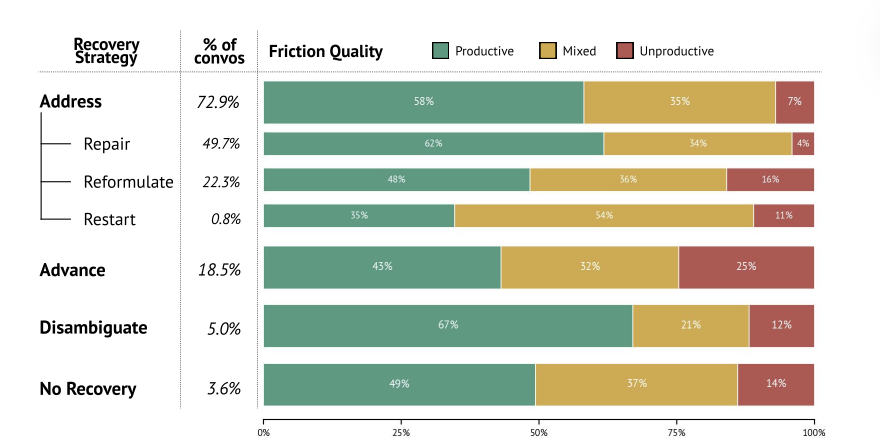
The figure shows different outcome distributions across recovery strategies. Collaboration can remain difficult after an active intervention, and a revision that moves the conversation forward may leave other problems unresolved. Human intervention therefore needs to target the relevant issue and be followed by a check of its effects.
Consider an illustrative customer analysis produced with AI. The employee first needs to explain the customer categories, business cycle, and purpose of the analysis. If the result shows an unexpected sales pattern for one customer group, the employee needs to return to order records and determine whether the issue stems from missing data, inconsistent definitions, or an inadequate explanation. Even after the AI revises its answer, the employee still needs to check whether the correction affects other conclusions.
This work depends on business knowledge, access to source material, and clear delivery standards. If employees are expected to take responsibility for results, the organization needs to establish what they are capable of checking, what evidence they can access, and how they should handle unresolved questions.
The management opportunity is to turn individual improvisation into practices that teams can use consistently. Frequently needed context can be prepared in advance. Recurring problems can inform review criteria. Issues beyond an employee’s expertise can follow a clear escalation path. In this way, experience correcting AI outputs can become an organizational capability.
More Interaction on Important Tasks Needs to Translate into Targeted Checks
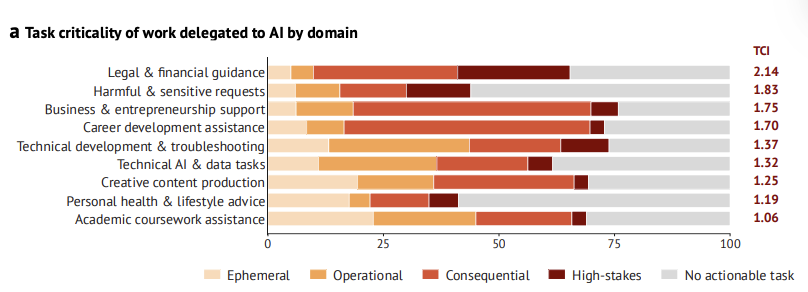
The study’s analysis of task criticality makes this division-of-work question more concrete. After excluding conversations whose task criticality could not be assessed, approximately 44% are classified as consequential and 12% as high-stakes—a combined share of about 56%. These categories describe potential consequences, not the proportion of tasks that caused actual harm.
More consequential tasks are associated with more interaction. Ephemeral tasks average 6.5 conversation turns, compared with 12.4 for high-stakes tasks—approximately 1.9 times as many. Users also make more specific requests.
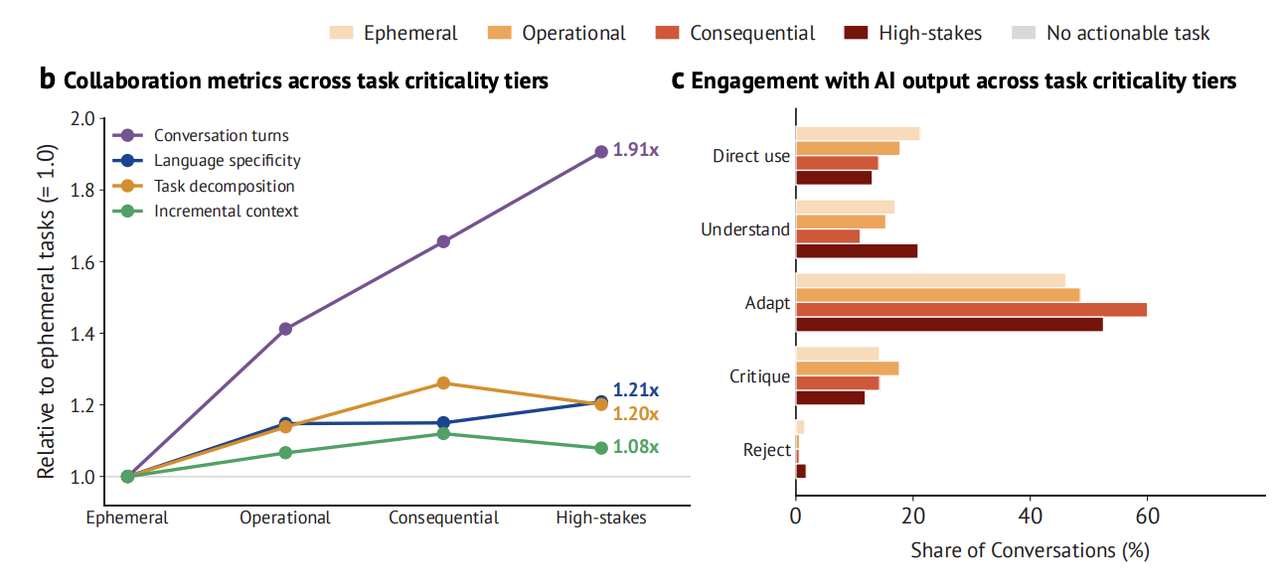
Conversation length shows the most pronounced change in the left panel. Task decomposition—the extent to which users divide work into smaller steps—peaks at the consequential level and declines slightly for high-stakes tasks. Requests become more specific as stakes rise, but the use of smaller, sequenced steps does not increase consistently.
The right panel shows how users engage with AI output. Among conversations where engagement can be assessed, adapting the output to the user’s context is the most common mode at every criticality level. It accounts for approximately 60% of consequential-task conversations and more than half of high-stakes conversations. Direct use of output declines from around 21% for ephemeral tasks to about 13% for high-stakes tasks.
These results show that different levels of task criticality are associated with different forms of participation. Determining whether additional interaction improves the result requires examining what happens during that interaction. Repeatedly revising the wording of a report may improve its presentation. Checking data definitions, reviewing calculations, and considering alternative explanations provide different evidence for assessing the reliability of its conclusions.
For companies, more consequential tasks call for clearer requirements about which checks must be completed. Material intended for team discussion may retain assumptions that have yet to be tested. Recommendations that will inform customer commitments or resource allocation require verification appropriate to those uses.
Organizations can structure human participation around specific review points: confirming data definitions before drawing conclusions, examining key assumptions before making recommendations, and establishing responsibility and conditions of use before execution. This creates a clearer connection between employees’ effort and the requirements of the task.
Conversation Data Reveals Participation; Work Outcomes Require Additional Evidence
This study gives external researchers access to patterns of real-world AI use. According to Anthropic, the teams designed their own research, while the company’s contractual review rights were limited to user privacy, information that could facilitate violations of its usage policies, confidential company information, and research accuracy. Researchers were free to publish findings unfavorable to Anthropic.
At the same time, privacy protections prevented researchers from reading the original Claude conversations. The researchers specified questions and classification rules; Anthropic’s tool analyzed the conversations; and the researchers then worked with aggregated outputs. Categories such as “human-led,” “friction,” and “productive recovery” therefore depend on model-based identification and classification.
How those rules were validated affects how the findings should be interpreted. The paper describes sampling 10 public WildChat conversations for each analytical dimension, comparing human annotations with model judgments, and refining the prompts until accuracy reached 100% on those samples. The team then examined whether the classifications produced meaningfully differentiated results across 10,000 WildChat conversations.
Agreement on samples used repeatedly to refine a classification rule shows that the rule fits those cases; accuracy on new conversations still requires independent validation. A distribution spread across multiple categories also does not establish that each conversation has been classified correctly.
The rules were then applied in a different usage environment. Anthropic acknowledges that WildChat skews toward casual and creative use and differs from actual Claude traffic. Some questions that performed well on WildChat produced misleading categories when applied to Claude conversations. This affects how confidently the resulting statistics can be interpreted.
More fundamentally, conversations can record what users ask and what revisions they request, but they do not fully capture checks performed in other systems, reviews by colleagues, or outcomes after the result is adopted.
Our management interpretation therefore needs a clear boundary: judgment and correction deserve explicit organizational design, while their resource requirements and contribution to delivery quality need to be tested within companies’ own tasks and workflows. Participation patterns alone cannot establish that human oversight is effective, nor can they show that human–AI collaboration creates a net additional burden.
Companies Need to Support the Human Work of Judgment and Correction
Companies seeking to make human review reliable can start with a specific task and clarify the responsibilities people are expected to take on.
First, delivery requirements should identify what must be checked. In a business-performance analysis, key figures should correspond to business records, calculations should be reproducible, and important judgments should state their assumptions and supporting evidence. What was checked, against which evidence, and what remains unresolved can become part of the deliverable. This helps the next person assess the result’s reliability and reduces the risk of duplicated or omitted checks.
Second, responsibility needs to match capability. Someone who can improve wording may not have the expertise to verify a specialist conclusion. Someone with business expertise may still lack access to the necessary data. Organizations should specify which checks the task owner can complete, which require specialist involvement, and when an issue should be escalated.
Time for verification matters as well. Employees need opportunities to inspect source material, investigate anomalies, and resolve uncertainty. When essential evidence is missing, they should be able to pause adoption of the result rather than accept unresolved issues to meet a delivery deadline. Responsibility for review needs to be supported by expertise, access to information, and the practical ability to act on concerns.
Finally, companies can include this work in their evaluation of AI applications. Alongside the time spent generating output, they should examine the effort required for review and rework, which errors are detected, which problems recur, and whether the final result meets the task’s requirements. These observations can help determine when an AI application is ready to expand and where the workflow still needs adjustment.
Nearly 250,000 real conversations show people contributing to AI-assisted work through input, revision, and correction. An important question for companies is whether these necessary human contributions have been clearly organized.
As AI takes on execution, the human role needs to be redesigned. When judgment and correction have defined objectives, accessible evidence, and adequate expertise and time, human-led collaboration has a stronger foundation for becoming a dependable way of working.
Further Reading
Yijia Shao, Dora Zhao, Vishakh Padmakumar, Jennifer Wang, and Diyi Yang, Human–AI Collaboration at Scale: Task Criticality, Agency, and Friction Across 250,000 Conversations, submitted August 21, 2026. The primary source for this article. Relevant sections include the methodology, human agency, conversational friction, and the classification definitions in Appendix A.
Anthropic, Enabling independent research on how people use Claude, published August 26, 2026. Describes the external research arrangements, privacy protections, researcher independence, and challenges in transferring analytical methods between data environments.
Anthropic, Enabling Independent Research: Public Aggregate Data. The Stanford data file contains category counts and cross-tabulations that can be used to check some of the percentages and denominators discussed in this article.
Sources and Copyright
This article was prepared by NextAI+ Praxis based on the Stanford SALT Lab team’s Human–AI Collaboration at Scale paper, Anthropic’s official research announcement, and the publicly released aggregate data. Research data and classification findings are attributable to the original research team and relevant data provider. The discussion of how companies should organize judgment and correction work—including responsibilities, working conditions, and evaluation practices—represents analysis and recommendations by NextAI+ Praxis. The customer-analysis and business-analysis scenarios are illustrative examples, not company cases reported in the study.
Figure 1 is excerpted from the Human Agency Scale illustration in Figure 2 of the paper. Figure 2 corresponds to the paper’s Figure 6, and Figure 3 to Figure 1b and Figure 1c. Percentages retain their respective statistical definitions; selected figures were recalculated from the public aggregate data. Different analytical dimensions treat “not applicable” cases differently, so their denominators should not be used interchangeably. Human-role classifications and friction prevalence are separate aggregate observations and should not be interpreted as joint characteristics of the same conversations.
Rights to the cited text, figures, and identifying marks remain with their respective authors, publishing institutions, or other rights holders. This article provides independent research commentary and does not represent an official position or endorsement by those organizations. Rights holders with questions about quotation, translation, or figure use may contact [email protected]. We will review the matter promptly and make corrections or remove material where appropriate.
Cite as · Deep Reads · 4 November 2026